Whiteboard Explainer 白板讲解
Einstein in Your Pocket·1:51·Lemo-Opuscarby Lemomo
An explainer drawn live on one glossy dry-erase board: single-line handwriting that is actually *written* stroke by stroke, floating markers with no hand, magnets that can move, an eraser that can rewind, and a camera that travels across the board instead of cutting.
The demo: How your phone knows where you are: GPS, atomic clocks, and the 38 microseconds relativity adds every day.
An explainer drawn live on one glossy dry-erase board: single-line handwriting that is actually written stroke by stroke, floating markers with no hand, magnets that can move, an eraser that can rewind, and a camera that travels across the board instead of cutting. References (grammar only): RSA Animate / Cognitive Media (one continuous board, the camera travels instead of cutting, a full-board view); minutephysics (one sentence = one drawing, the simplest geometry that carries the idea); Steve Reich's Piano Phase (two copies of one figure at two tempi as a structure). Never copy their drawings, characters, hands or music.
Suits explainers of 60–120 s, usually science or "how does X work".
1. Essence, and what it is not
- One physical whiteboard. Everything the viewer learns is drawn in dry-erase marker in front of them, in real handwriting order.
- The board is a map: each idea lives in its own region; the camera travels between regions, often led by the pen. Distance on the board = distance in the argument.
- Real marker, not animated text: ink pools where the nib lands, dry streaks and speckle, strokes overshoot and don't quite close, ghosts of old lessons remain, a glossy sheen drifts slower than the board, and every stroke makes a sound.
- No hands. Markers float with a real cast shadow that grows when they lift, park outside the frame between phrases and fly back in. Magnets and the eraser move on their own. Never draw a hand, an arm or a cursor.
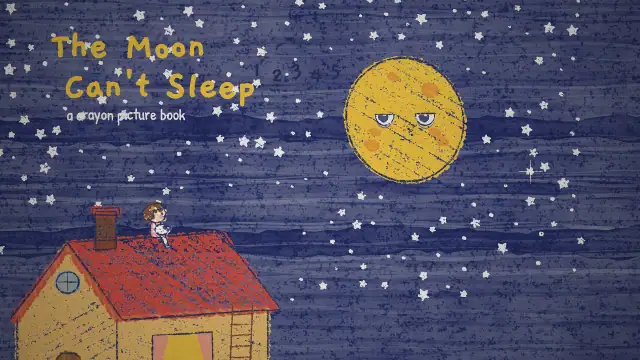
Not Blueprint (no blue sheet, no drafting conventions), not Crayon Picture Book (no wax texture, no children's story), not a kinetic-type explainer (text is handwritten stroke by stroke, never animated as blocks).
2. Materials & rendering
- Board: a warm white gradient, a faint scuff and micro-scratch tile, a few dozen ghost marks (old words, circles, arrows) at 5–10 % in grey or pale blue, and a soft diagonal window sheen (white, 10–16 %) moving at ~0.35× the camera: this one detail sells "glossy".
- Ink: alpha ~0.94, composited with multiply so overlaps darken like real marker. Width 6–11 px for drawing, ~13 % of cap height for lettering.
- Stroke character: resampled every ~0.6 × width; low-frequency hand wobble along the normal (a few px, long wavelength) plus a finer tremor; chisel-tip width modulated by direction; a pressure ramp at the start and a small taper at the end; circles start at an angle and overlap past closure; rectangles are four strokes with small corner overshoot; a darker pooled dot inside the start of long strokes.
- Dry-marker texture: a speckle-and-streak tile subtracted from the ink layer (destination-out), locked to board space, faded out when the camera is wide.
- Lettering: a single-line (single-stroke) font written in stroke order, each glyph with small rotation, baseline and scale jitter. Missing symbols (μ ≈ → × − ✓ ² ° ±) are hand-defined.
- Props: dry-erase markers (white barrel, colour band and cap in the ink colour, felt nib), a felt eraser, magnets (glossy, with specular highlight and soft cast shadow). Frame, tray and wall appear only if the camera ever goes past the board edge.
3. Colour logic
- Three marker colours at most, each with a meaning held for the whole film: one dark ink for things and structure, one for signals / measurement / process, one accent for the thing that matters (one accent per region).
- Monochrome variant: everything in the dark ink, one element in the accent (the "only colour").
- Ghost marks and board stay neutral; the accent never appears on props except its own marker cap and the hero magnet.
- Example sets: black
#23262c/ blue#2a5cb3/ orange#d97757; black / green#2e8b57/ red#c8363a; navy#1f2a44/ teal#1f8a8a/ purple#7a4fb3.
4. Type & subtitles
- Handwriting only: a single-line hand (e.g. EMS Tech, OFL) for all board text; titles large (~120–200 px cap height), labels 30–70 px.
- Title and end card are written on the board in the same hand.
- Burned subtitles: an off-white rounded label (~90 %), a handwriting-like face (e.g. Architects Daughter ~44 px), dark text, a short accent-colour marker dash. Split at clauses, ≤ 44 characters per line, bottom ~12 % of the frame kept free for them in every shot. Hold ≥ max(1.8 s, speech + 0.6 s).
- Writing finishes on the word: a term appears exactly when the narrator says it.
- A label is fully in or fully out of every shot it appears in.
5. Motion quality
- Hand speed: every stroke follows a slow-fast-slow curve (
u − sin(2πu)/2π × 0.8). Strokes are scheduled into a time window and the engine solves the speed, so writing always finishes on time. - Pen hops between strokes lift in proportion to distance (shadow slides and blurs); long gaps send the pen off-frame to park and back shortly before its next stroke.
- Magnet: drop with a shrinking shadow; slide with a small lift; lift-off and sink possible.
- Eraser: constant speed along a path, a wide band at ~90 % strength (a ghost always remains).
- Speed: faster than real hands (a sped-up lesson) but never so fast the stroke order is lost: a label ~0.3–0.8 s, a title ~3 s.
- Camera on ones with real motion blur when it moves fast.
6. Camera grammar
A 2D camera over a large board (e.g. 8000 × 4500): position, zoom interpolated in 1/z so pushes feel like dollies, a little roll. A vocabulary, not a route. Opening and ending come from the topic.
| Move | What it expresses | Can serve |
|---|---|---|
| Pull back from a tiny drawing | scale | a surprising size; context |
| Ride the line the pen is drawing | one idea leads to the next | a transition; a process; a path |
| Hold still | read now | an equation; a definition; a list |
| Whip to a new region | a new idea after a pause | a twist; a "but" |
| Return to an earlier region | a callback, for free | reusing a result; a comparison |
| Split view of two regions (zoomed out enough for both) | two things at once | a duet; before/after |
| Slow push into one symbol | this term is the point | a unit; a variable; a name |
| Track along a long diagram | sequence, time | a timeline; a pipeline; a journey |
| Pull back past the board edge to the wall | the whole lesson as one picture | a summary; a scale jump |
Motion blur: when the camera moves more than ~14 px per frame, render and average sub-frames (≤ 4 px apart). No cuts on the board; if a cut is needed, it is a whip.
7. Sound palette
- Every stroke sounds: band-passed felt-on-gloss noise (a hiss band ~2–7.5 kHz + body ~0.5–1.5 kHz) enveloped by the stroke's own speed curve, a tiny nib tick at the start, stick-slip grains, and on some long strokes the dry-erase squeak (a 1.5–2.6 kHz sine with 7–13 Hz vibrato). Each colour sounds slightly different. Pan = the stroke's screen x; closer camera = louder.
- Props: magnet on steel = click + metal modes + a low board thump; eraser = felt rub modulated by its zig-zag; cap off/on; marker tray bounce.
- Room: low room tone; a single diegetic ticker (a wall clock, a fridge hum, a projector fan) can own a silence.
- Music options: a solo piano figure; a small jazz trio with brushes; plucked strings and kalimba; a synth arpeggio for tech topics; clockwork minimalism (marimba, pizzicato, woodblock, glockenspiel). Mickey-mouse details: a rising whistle for growth, pings for signals, a harp run for a fall.
- Techniques to pick from: adding one instrument per step of a mechanism; a key change when the frame of reference changes; a full stop into silence before a surprise; the previous cue reversed and squeezed for a rewind; two copies of one figure at two tempi (phasing) for anything that diverges, snapping into unison when resolved.
- Mix: voice on top (compressed, light room), music well under voice and ducked further under speech, foley ~11 dB under voice; −14 LUFS.
8. Native moves
A menu: use the ones your story needs.
- Writing in stroke order. The reveal is the explanation: a formula term by term as it is spoken. Fits content like: compound interest; the Drake equation; a recipe's ratios.
- The pen leads the camera. Transitions are drawn lines the camera rides. Fits content like: a nerve signal; a supply chain; the water cycle.
- Magnets. The only things allowed to move on a board: give the hero to a magnet; slide, lift, drop, sink it. Fits content like: a delivery truck on a route; a cell in a bloodstream; a player on a pitch.
- The eraser rewinds. Wiping a trail backwards reads as undoing time. Fits content like: an undo in software; reversing a chemical reaction; "what if we hadn't…".
- Two pens at once. A live duet comparing two quantities. Fits content like: two savings plans; two runners; a population vs its food supply.
- Ghosts of the old lesson. A faint previous drawing becomes relevant. Fits content like: a theory replaced; last year's forecast; a first draft.
- The full-board view. Every region seen at once as one picture. Fits content like: a system diagram; a history; a map of a field.
9. Pitfalls of the medium
- One pen, too many jobs drifts later and later → give each drawing a deadline window and let overlapping jobs go to another pen.
- Minimum stroke duration × many dashes makes a dashed line take seconds → dashes need their own floor.
- A pooled-ink dot bigger than the stroke start leaves halos on every letter → keep it inside.
- Punctuation vanishes (a font period is a 1 px stroke) → render sub-width strokes as dots.
- Labels half-cut by a push-in look sloppy.
- Motion blur with few sub-frames strobes text.
- Eraser paths crossing labels you want to keep.
- Voice and phoneme set mismatch (a British voice with US phonemes) mispronounces → match the language code to the voice; ASR-check.
10. Engine
demo/engine/wb.js: hand-drawn shapes (line, curve, poly, arc, circle, rect, arrow, dashed, hatch), text() in writing order from a single-line font (loadFont), Stroke, floating Pens, Timeline.draw(pen, shapes, t, {by}) (solves hand speed to a deadline), Timeline.erase, Timeline.cue, keyed Camera, Board (ink multiply, dry texture, erasers, sheen, props), prop drawers. API table and a minimal example that draws something new: DEMO.md.
11. Variation space
You decide the topic's object, the board layout, the colours within the logic, the voice, the music family, the camera route, the opening, the ending and the length.
All far from our demo:
- Structures: a proof (one claim at the top, the board fills downward step by step, each step boxed when proven); a debate (two pens, two halves of the board, each drawing its side until the drawings meet in the middle); a timeline (one long horizontal line ridden left to right, with events hanging off it).
- Openings: a question mark drawn huge in the centre, then shrunk to become a dot in the first diagram; an erased board where the ghost of a wrong answer is still visible; a magnet dropping onto an empty board with a clack.
- Endings: the answer circled twice and the pen capped; the board wiped except for one line that survives; a push into the smallest symbol on the board, which becomes the title.
How our demo was made (story, shots, score, end card, build): DEMO.md. Read it after your treatment exists.
Director's notes for the demo film
One example among many. Don't reuse its story, arc, shots, props or timings.
Demo: Einstein in Your Pocket (111 s) · whiteboard.mp4 · source in demo/
The demo's original one-line pitch: A science explainer drawn live on one glossy dry-erase board: single-line handwriting that is actually written stroke by stroke, floating markers with no hand, a magnet that can move, an eraser that can rewind time — and a camera that never leaves the board until the final pull-back shows the whole lesson hanging on the wall.
Story & structure
Why GPS needs relativity, told from the map pin on your phone. The original style notes, as written for this demo:
A lesson on one physical whiteboard. Everything the viewer learns is drawn in dry-erase marker in front of them, in real handwriting order. The board is a map: each idea lives in its own region, and the camera travels between regions, usually led by the pen (the pen draws a line, the camera rides it). At the end the camera pulls back and the viewer sees that the whole explanation was one picture.
What makes it feel real rather than "animated text": ink that pools where the nib lands, dry streaks and speckle, strokes that overshoot and don't quite close, ghosts of old lessons that were never fully wiped, a glossy sheen that drifts slower than the board, and a sound for every stroke.
This version has no hands. Markers float (with a real cast shadow that grows when they lift), park outside the frame between phrases and fly back in. Physical props (magnets, eraser) move on their own. Don't draw a hand, an arm, or a cursor.
| Native power | How the demo used it |
|---|---|
| Writing in stroke order | The reveal is the explanation: an equation appears term by term exactly when the narrator says the term. |
| One board, one camera | Distance on the board = distance in the argument. Returning to an earlier drawing is a free callback (the demo returns to its first equation to compute 38 μs × c ≈ 11 km). |
| The pen leads the camera | Transitions are drawn: an orbit, a signal line, a trail. The camera follows the line to the next idea. |
| Magnets | The only objects allowed to move on a whiteboard. Give the hero (the "you are here" pin) to a magnet; it can be lifted off, dropped, slid, sunk. |
| The eraser rewinds | Wiping a trail backwards reads as undoing time. The demo used it once, right after the joke. |
| Two pens at once | A duet: two quantities compared live (the demo: ground clock vs orbit clock ticking at two tempi). |
| Full-board reveal | The demo's ending: pull back past the frame to the wall and the pen tray. Every earlier scene reappears at once. |
Demo story shape: hook on one tiny object (the pin) → scale reveal → title on the first downbeat → mechanism in 3 steps → silence + "But, there's a catch." → the twist explained with a visual duet → a joke that shows the consequence (the pin drifts one day per beat into the sea) → the eraser rewinds → the fix, in sync → pull back to the whole board → end card written under the title.
How we found the topic's handle (the same recipe works for others): find one object the viewer owns (the phone, a loaf, a lightbulb), one number that surprises, and one consequence you can walk across the board. Put the surprise in the middle, after a silence.
Shots
- A 2D camera over an 8000 × 4500 board: position, zoom (interpolated in 1/z so pushes feel like dollies), a little roll.
- Grammar: (1) pull back to reveal scale; (2) ride the line the pen is drawing; (3) hold still whenever the viewer must read; (4) one whip into a new idea after a silence; (5) one final pull-back beyond the frame.
- Real 180° motion blur: when the camera moves more than 14 px per frame, render up to 12 sub-frames and average them.
- Keep the bottom 12 % of the frame for subtitles in every shot.
In the demo the camera never left the board until the final pull-back, which showed the whole lesson hanging on the wall with its aluminium frame and pen tray.
Demo motion numbers: pen hop lift 35 % of the window max; gaps > 0.75 s send the pen to park, returning 0.42 s before its next stroke; magnet drop 0.3 s, sink = tilt 0.5 rad and drop 40 px; eraser band 90–230 px at 90 % strength; title 3 s, a label 0.3–0.8 s, a full satellite ~1 s. The original motion section:
- Hand speed: every stroke follows
u − sin(2πu)/2π × 0.8— slow landing, fast middle, slow lift. Strokes are scheduled into a time window (the engine solves the speed), so writing always finishes on the word. - Pen hops between strokes: lift proportional to distance (shadow slides away and blurs), 35 % of the window max. Gaps > 0.75 s: the pen flies off to a parking spot outside the frame and returns 0.42 s before its next stroke.
- Magnet: drop = 0.3 s with lift → 0 and a big shadow shrinking; slide = smoothstep per step with a small lift; sink = tilt 0.5 rad and drop 40 px.
- Eraser: follows a path at constant speed, wipes a 90–230 px band at 90 % strength (a 10 % ghost always remains).
- Speed: title 3 s, a label 0.3–0.8 s, a full satellite ~1 s. Faster than real hands — this is a sped-up lesson — but never so fast that the stroke order is lost.
Score structure
- Every stroke sounds: band-passed felt-on-gloss noise (2.2–7.5 kHz hiss + 0.5–1.5 kHz body) with the stroke's own speed curve as envelope, a 4 ms nib tick at the start, random stick-slip grains, and on ~28 % of long strokes the dry-erase squeak (a 1.5–2.6 kHz sine with 7–13 Hz vibrato). Blue marker slightly darker, orange slightly brighter. Pan = the stroke's screen x; closer camera = louder.
- Props: magnet on a steel board = click + metal modes (830/1370/2210/3120 Hz) + 140 Hz board thump; eraser = 250–2600 Hz felt rub modulated by its zig-zag; tray = plastic bounces + aluminium ring; cap off/on.
- Room: low room tone and a wall clock that ticks the ground clock's seconds — it is the only sound during the silence.
- Score: clockwork minimalism at 120 BPM, D major / B minor: marimba 8th-note arpeggio, cello + bass pizzicato, woodblock tick on every beat, glockenspiel theme, shaker/claps only in loud sections. Signals get glockenspiel pings, a falling signal gets a harp run, a drifting object gets a staccato march (tuba + bassoon, chromatic descent). For any "two quantities that diverge" moment, run the same figure at two tempi (phasing), then snap them into unison at the fix. Rewind = the previous cue reversed and squeezed.
- Mix: VO on top (compressed, light room), score 6.5 dB under VO RMS and ducked another 9 dB under speech, foley ~11 dB under VO; −14 LUFS.
Palette & props
- Board: warm white
#fbfbf9 → #eeede9gradient, a faint scuff/micro-scratch tile, ~46 ghost marks (old words, circles, arrows) at 5–10 % in grey#9aa0a8/ pale blue#8aa0c8. A soft diagonal window sheen (white, 10–16 %) that moves at 0.35× the camera — this one detail sells "glossy". - Ink: black
#23262c, blue#2a5cb3, orange#d97757, alpha 0.94, composited with multiply so overlaps darken like real marker. Width 6–11 px for drawing, 13 % of cap height for lettering.- Colour semantics: black = things and structure, blue = signals, light, measurement, orange = you / time / the thing that matters (one accent per scene). Monochrome variant: keep one element orange (the "only colour").
- Stroke character: resampled every ~0.6 × width; low-frequency hand wobble along the normal (±2.6 px, wavelength ~220 px) plus a finer tremor; chisel-tip width modulation by direction (0.8–1.0); pressure ramp at the start (0.72 → 1) and a 12 % taper at the end; circles start at an angle and overlap past closure; rectangles are 4 strokes with small corner overshoot; a darker pooled dot just inside the start of every long stroke.
- Dry-marker texture: a 512 px tile of speckles and short streaks subtracted from the ink layer (destination-out), locked to board space, faded out when the camera is wide.
- Lettering: single-line font EMS Tech (OFL, a single-stroke version of Architects Daughter), every glyph with ±2° rotation, ±3.5 % baseline and scale jitter. Missing glyphs (μ ≈ → × − ✓ ² ↓ ° ± .) are hand-defined in the engine. Title 200 / 120 px cap height, labels 30–70 px.
- Props: dry-erase markers (white barrel, colour band and posted cap in the ink colour, felt nib), a charcoal felt eraser with a small orange label, one glossy orange map-pin magnet (radial gradient, white dot, specular highlight, soft cast shadow). Aluminium frame and pen tray only appear in the final wide shot, on a warm grey wall
#d8d3ca.
Titles & end card
- Title and end card are written on the board in the same single-line hand; the end card is written under the title so the film ends where it began.
- Burned subtitles: off-white rounded label (90 %), Architects Daughter 44 px, dark ink text, a short orange marker dash bottom-left. Split at clauses, ≤ 44 chars per line, short clauses merged, two lines above 1250 px.
The demo's end card is written under the title in the same hand (demo/film.js, block END CARD, from 103.3 s): "Whiteboard Explainer", "Lemo-Opuscar" in orange, "LemoLab × Claude Opus 5.5", then voice, lettering and sample credits in small type; the pen caps at 107.3 s. The "LemoLab × Claude Opus 5.5" sign-off belongs to this library's demo only; a user's film carries no LemoLab credit and no copy of this card (take those credit() lines out when reusing the code).
Build notes
- Write the script as short lines (
demo/lines.json), synthesize withcore/tts/tts.py(voicebm_george,lang: en-gb), check withdemo/tools/asr_check.py(WM=medium.en) →voices/words.jsonword times. - Lay out the board (regions for each idea), then write
demo/film.js: VO start times, drawings hung on spoken words withat(id, word), pens, camera keys. node core/render/events.mjs demo→events.json(every stroke, wipe, magnet, cue anchors).music.py(reads the same events) →mix.py(foley generated from events + VO + ducked score).node core/render/video.mjs demo --fps 24→core/render/mux.sh … 24 2. Whole film renders in ~30 s.demo/build.shdoes steps 3–5 plus subtitles, poster and stills;--voalso redoes step 1.
Pitfalls we hit
- One pen, too many jobs: a single pen scheduled back-to-back drifts later and later (satellites arrived 12 s late). Give every drawing a window (
by:) and let overlapping jobs go to another pen. - Minimum stroke duration × dashes: a 60-dash line with a 0.09 s floor takes 6 s. Dashes need their own tiny floor.
- Pooled-ink dot bigger than the stroke start → grey halos on every letter. Keep the dot inside the stroke.
- Punctuation vanishes: a font period is a 1 px stroke. Render sub-width strokes as dots.
- Labels half-cut by a push-in look sloppy: a label must be either fully in or fully out of every shot it appears in.
- Motion blur with few sub-frames strobes text. Step ≤ 4 px between sub-frames.
- British voice + US phonemes: Kokoro
bm_georgewithlang: en-ussaid "clocks" like "Clarks". Useen-gbfor British voices; check withmedium.en. - Keep eraser paths off labels you want to keep (it wiped half of "orbit" once).
Engine reference
| Function | What it does |
|---|---|
loadFont(name, url) |
Load a single-line font converted by demo/tools/svgfont2json.py ('tech' = EMS Tech) |
line / curve / poly / arc / circle / rect / roundRect / arrow / dashed / hatch |
Hand-drawn shapes → Stroke / Stroke[]. Options: w, color, jitter, over (overshoot), bow, lap (circle overlap), clip (rounded rect), alpha |
text(str, x, y, {h, align, w, color, font}) |
Handwritten text as strokes in writing order (h = cap height) |
new Stroke(points, opts) |
Any path (flat [x,y,…]) in marker style |
new Pen(id, color, {park}) |
A floating marker; park = its off-frame spot in screen px |
Timeline.draw(pen, shapes, t, {by, speed, minGap, maxGap}) |
Schedule strokes; with by the hand speed is solved to finish on time |
Timeline.erase(path, t, dur, {width, strength}) |
Felt eraser along a path (leaves a ghost) |
Timeline.cue(t, type, extra) |
Extra sound/music anchors exported to events.json |
new Camera([[t, x, y, zoom, roll, ease], …]) |
Keyed 2D camera; ease io i o l s |
new Board(tl, {ghosts}) · board.render(ctx, t, cam) |
Board, ink (multiply + dry texture + erasers), sheen, objs (world props) and overlays (screen) |
penPose / drawMarker / drawEraser / drawPinMagnet |
The physical props |
Minimal call — draw a warm-orange four-point sparkle with a short cursor tail, in marker:
import * as W from './engine/wb.js';
await W.loadFont('tech', 'fonts/EMSTech.json');
const tl = new W.Timeline(), O = new W.Pen('orange', '#D97757');
const star = [], cx = 960, cy = 540, R = 120, r = 26;
for (let i = 0; i <= 8; i++) { const a = i * Math.PI / 4 - Math.PI / 2, q = i % 2 ? r : R; star.push([cx + Math.cos(a) * q, cy + Math.sin(a) * q]); }
tl.draw(O, [W.poly(star, { w: 10 }), W.line(cx + 150, cy + 60, cx + 150, cy + 150, { w: 10 })], 0.5, { by: 1.6 });
tl.draw(O, W.text('ready', cx + 190, cy + 150, { h: 60 }), 1.7, { by: 2.4 });
tl.end();
const board = new W.Board(tl), cam = new W.Camera([[0, 960, 540, 1]]);
board.objs.push({ draw: (ctx, t, c) => W.drawMarker(ctx, O, W.penPose(O, t, cam), c, t) });
window.render = t => board.render(ctx, t, cam);           // ctx = your 1920×1080 canvas 2D context
Single-colour variant: draw everything with the black pen and give only the element that matters { color: '#D97757' }.