Red Paper-cut 红色窗花剪纸
Nian Comes to Town·49s·Lemo-Opuscarby Lemomo
Chinese window-flower paper-cuts brought to life: jointed red cut-outs on paper grounds, where the cut *is* the drawing and the holes are where the light gets in.
The demo: On New Year's Eve the beast Nian comes to town, and one girl's giant paper-cut lights up the village to scare it off.
Chinese window-flower paper-cuts brought to life: jointed red cut-outs on paper grounds, where the cut is the drawing and the holes are where the light gets in. References (grammar only): folk window flowers of Shaanxi and Yuxian (sawtooth, crescent, cloud and swirl cuts, fold-symmetric rosettes, yin and yang cutting); the 1958–59 Shanghai Animation Film Studio cut-paper shorts (jointed figures, profile acting, paper layers in parallax). Copy no studio character, no named artist's work and no real motif sheet: generate every pattern from code, and never name the references in the film.
1. Essence, and what it is not
Every visible thing is a piece of paper that was cut with scissors and laid flat on another sheet. There is no painting, no gradient shading, no outline stroke: detail, volume and expression come only from what was cut away. Red paper is the hero material; grounds are paper too (a light paper by day, a deep dyed paper by night). Characters are jointed cut-outs (head, torso, upper and lower limbs pinned at rivets) animated in hard 12 fps steps.
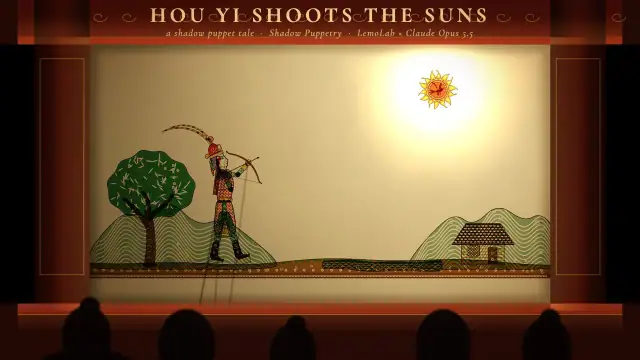
Not shadow puppetry: no light behind a screen, no translucent dyed hide, no rods. Here the paper is front-lit and opaque; backlight is a special event you save for the moment that needs it. Not flat vector art (no strokes, no gradients), not a silhouette film (every shape's interior is cut).
2. Materials & rendering
- Paper grain: a neutral-grey texture in
soft-lightinside each piece (dye mottling, fibres, specks), then the piece's alpha restored withdestination-in, so holes stay holes. - Cut edge: every silhouette is a polyline with a slight low-frequency wobble (hand-cut), a 1 px light rim upper-left and a dark rim lower-right (the cut face). Architecture and machines use straight segments + wobble, never smoothing.
- Paper thickness: each piece casts a tight soft shadow on the layer below; stacked folded paper shows 2–6 offset darker edges.
- Figures: red block + yin lines. Every figure piece gets an inset contour (a thin slit a few units inside the outline): the classic double outline, which also separates red-on-red overlaps (an arm over a coat).
- Folk cutting vocabulary (
demo/motifs.js): sawtooth rows (fur, grass, tiles, fringe), serrated edges, crescents (scales, quilting), swirls (joints), clouds, rosettes, plum, coin, tapered slits. - No floating islands. A closed ring cut would drop its centre out of real paper. Eyes are two crescents (upper and lower lid) that leave bridges, plus a pupil hole.
- Faces never morph: expressions are swappable face pieces (smile, surprise, fear, determined, asleep).
- The rosette (团花) is designed as one 45° wedge and mirrored 8× (D4); other folds give 2×, 4× or 6×. Alternate rings of yang cut (band cut away, red lines left) and yin cut (lines cut out of a red field). Fold seams leave faint crease lines: keep them, they are true to the craft.
- Light: front-lit scenes use the paper as is. Night:
frame × lightmap+ warm pools, then emissive backlit pieces (light × paper transmission viamultiply; holes at full light), a two-level bloom and optional rays. Keep bloom low enough that the pattern stays legible at the centre. - Projected pattern: a piece's hole mask, squashed onto the ground and added with
lighter; on a character, masked by its layer alpha over a solid warm spot, so cut features still read as holes.
3. Colour logic
- China red (around
#d2201f, range#c8102e–#d7261e) is the hero material. Depth and role are shown by paper tones one step apart, not by shading: near pieces one step brighter, far pieces one step darker, an antagonist or a heavy object one step deeper. - Ground and hero must be different paper families. If background and hero are both red, the silhouettes stop popping. At night, all background layers are one dark dyed family and only the pieces that matter to the story are red; by day, a light paper ground with red and pale-red layers.
- Gold foil is an accent kept for one late moment (a sun, a title, a coin); never a second main colour.
- Examples of ground families: indigo night papers (far layers lighter blue, near darker); a warm rice-paper day with pale-red far hills; a jade-green or black paper for a story that isn't festive. Choose from the topic.
4. Type & subtitles
- Subtitles are a paper strip in the world, e.g. a red banner (横批) darker than the picture's reds so cream text holds, serrated edges, swallow-tail ends; a sturdy OFL serif (e.g. Fraunces SemiBold) around 44 px, low, with a paper shadow. It drops in on two 12 fps steps, like a couplet being pasted. Hold ≥ max(1.8 s, speech + 0.7 s); never overlap.
- Titles are cut-out letters (yang-cut, counters are real holes) popping in letter by letter on 12 fps steps, with sawtooth border strips and a seal cut by code.
- Small credits may be printed ink on paper.
5. Motion quality
- Characters step at 12 fps (pose sampled at
floor(t·12)/12); camera, light, weather, flames and flying pieces move on ones at 24 fps. - Rigs pin pieces at rivets (neck, shoulders, elbows, hips, knees, jaws, tails). Hard poses, tiny eases, 1-frame overshoots ("pop" = 1.15× for one step). Weight comes from size and camera shake.
- In profile, a raised near arm crosses the face: keep hands forward of the face or let a prop cover them.
- Folding: the flap is split into ~16 strips; each is compressed by cosθ and enlarged along the fold by
1 + 0.28·height(fake perspective), darkened as it stands up, in a lighter back colour past 90°, with a growing shadow and a crease after. About half a second per fold, each on a hit. - Cutting: the pattern is revealed through a mask of circles along the scissor path; the offcut drops once the outer edge is passed; blades open and close on a subdivision of the beat; scraps flutter out and land.
- Unfolding: successive unfolds a fraction of a second apart, each flap swinging from folded to flat with ease-out (the "pa!" snap), then a scale bump and warm flash on the accent.
6. Camera grammar
A vocabulary, not a route. Opening and ending come from the topic.
| Move | What it expresses | Can serve |
|---|---|---|
| Extreme close-up tracking the scissor tip | making; attention to craft | a beginning of work; a precise act; a signature |
| Flat front view, locked | the cut-out as an emblem | a title; a statement; a family portrait |
| Slow pan across paper layers (parallax) | a world laid out | a village, a route, a timeline |
| Low wide, a shape standing up from the ground layer | scale, threat | a storm; a rival; a deadline arriving |
| Top-down tabletop | the craft as plot | folding, cutting, assembling, sorting |
| Push toward a lit piece, pull back to many | one act spreading | influence; a network lighting up |
| Page turn / sheet peel | time or place changing | day to night; before and after; chapters |
| Pull back to an object in a room | the film was a thing someone made | memory; a gift; a tradition |
| Rotation around a rosette's centre | order, repetition | a cycle; a team |
Framing: layers stay parallel to the screen; depth comes from parallax and paper tones, never from perspective. Transitions are paper actions (fold, page turn, peel, a sheet flying off, a cut through the frame); no dissolves.
7. Sound palette
- Foley follows the material: scissors = metallic shear sweep (2.5–9 kHz) + a short ring + a fibre crack; folds = swish + crease tap; unfold = sharp snap; heavy steps = cardboard thud, not flesh; paper peel; pasting = a palm pat; match strike, puff; firecrackers = dense clicks 20–60 ms apart with low booms.
- Instruments: a bright Chinese chamber ensemble, not piano and strings and not the opera percussion of shadow puppetry: pipa (tremolo on long notes), zheng (
dan_tranh: broken chords, glissandi, tremolo), erhu (glides), dizi (flute), sheng or yangqin colours, woodblock, small and big gong, frame drum. Pentatonic modes. - Options: one snip = one beat subdivision; a rising zheng run, one note per thing that appears; a frame-drum heartbeat for weight; one big gong saved for one accent; total silence for a held breath.
- Voice: warm storyteller, few lines. Duck music ≈ 9 dB and foley ≈ 3 dB under the voice; keep impacts out of voice windows. Folk names may need an
asralias inlines.json. - Mix to −14 LUFS, no film grain (the paper fibres are the texture).
8. Native moves
A menu: use the ones your story needs.
- Fold – cut – unfold. Fold a sheet 2/4/8 times; one cut becomes many. Put the unfold on a strong beat. Fits content like: one teacher, many students; a single design mass-produced; one seed becoming a field.
- Holes are light. A cut-out lit from behind glows deep red, every hole glows, and the pattern is projected onto the world. Fits content like: an idea shining through a person; a lighthouse; a window at night in a story about home.
- Symmetry replicates. A mirrored motif peels off and multiplies (rosette → window flowers → fireworks). Fits content like: a franchise; cell division; a song spreading through a crowd.
- Scraps have a future. The bits that fall while cutting come back later (as snow, confetti, stars). Fits content like: recycling; leftover time; small failures that add up.
- Everything is one flat sheet. Things share the same cuts, so a ridge can stand up and be a creature, or a wave become a road. Fits content like: a landscape that becomes a map; a factory that turns out to be one machine; a zoom out to the made object.
- Mirrored pair. Two figures cut from one folded sheet. Fits content like: twins; a partnership; before/after of the same person.
9. Pitfalls of the medium
- Red on red reads as one blob → different ground family, near/far paper tones, inset contours for overlaps.
- Darkening a layer through the light map also darkens what covers it → tint the layer itself (multiply + restore alpha).
- A flat cos-squashed flap reads as a sliding card, not a fold → strips with fake perspective, darken as it stands up, show the back colour.
- Cut reveal shows the uncut stack through the holes → stack thickness inside the "uncut" mask only; the cut part gets its own offset copies.
- Scissors pointing backwards → the blade axis follows the direction of travel, the rivet a little behind the cutting point.
- Blank frames between shots → overlap outgoing and incoming paper actions.
- Engine traps (
put()transforms, piece boxes, test pages) are in DEMO.md build notes.
10. Engine
In demo/: paper.js (paper textures, piece builder: fill, cut, inset, edge, grain, shadows, transmission), motifs.js (folk pattern library), rig.js (2D affine rig helpers), tuanhua.js (8-fold rosette from one wedge × D4), light.js (night lightmap, backlit pieces, bloom, rays, masked projected light), fold.js (fold – cut – unfold sequence), hud.js (subtitle banner, cut-letter text); ?test= pages draw model sheets from the real engine. A first test not in the demo: a bicycle from paper.js pieces (sawRow spokes), wheels riveted in rig.js, rolling on 12 fps steps.
11. Variation space
You decide the structure, the cast (or none), the sets, the paper families, the opening, the ending, the camera path, the pacing and which native moves carry the story. All far from our demo:
- Structures: a year of twelve cuts (a zodiac or calendar wheel, one wedge per month, rotating); an assembly line (a product built piece by piece from cut parts, each part a pattern); a letter (a folded message unfolds panel by panel, each panel a scene).
- Openings: a finished pattern (a full rosette, then one piece falls out and walks away); an empty ground (a blank sheet, one fold crease appears); a crowd of cut figures already dancing, parallax full.
- Endings: refold (the world folds back into a small square that is handed to someone); scraps settle (every offcut drifts down into a new pattern); backlit only (the lights go off except behind one cut piece, which projects the last image on the wall).
How our demo was made (story, shots, score, end card, build): DEMO.md. Read it after your treatment exists.
Director's notes for the demo film
One example among many. Don't reuse its story, arc, shots, props or timings.
Demo: Nian Comes to Town (49 s) · papercut-red.mp4 · source in demo/
Story & structure
New Year's Eve: the monster Nian comes into the village and every house puts out its lights. A little girl folds a sheet of red paper three times and makes one cut; the unfolded rosette goes on her window, a candle is lit, eight cut lanterns fly to eight dark windows and the whole village lights up again; the scraps she cut off become firecrackers, and Nian runs from the red light and the noise. At dawn the camera pulls back: the whole film was one window flower pasted on a real window.
The brief this film was written to (and the rule it followed for itself): choose a story where the craft of cutting paper is the plot, use several native moves, and make one of them the cause of the ending, not decoration. Here the fold – cut – unfold is the cause: one lantern cut in the wedge = eight lanterns in the rosette = eight houses lit.
How the demo framed "adapting any topic": find the one thing that gets cut and make its unfolded form the answer (a product's silhouette folded into a wedge that unfolds into all its uses; two lovers cut from one folded sheet; one house cut in a folded strip that unfolds into a street). Treat these as examples of the fold move, not as a required structure.
Arc (40–55 s as planned, 49 s delivered): cold open on the scissors (0–3 s) → title → peaceful world → threat (the world goes dark and silent) → a quiet decision → fold–cut–unfold on the downbeat → the pattern becomes light and fixes the world → dawn → scale reveal.
Native moves spent: fold – cut – unfold (the climax), holes are light (the backlit rosette on the window, its pattern projected across the snow onto Nian's face), symmetry replicates (the rosette's lanterns fly off; small rosettes unfold as fireworks), scraps have a future (the offcuts come back as firecrackers), everything is one flat sheet (the sawtooth ridge of the far hills stands up and is Nian's back; the final pull-back to the window).
Shots
120 BPM, 2/4: one beat = 0.5 s, one bar = 1.0 s.
| # | Time (s) | Picture | Camera | Sound |
|---|---|---|---|---|
| S1 | 0.0–3.0 | Black 0.25 s → scissor blades bite red paper; two scraps fall; at 2.4 the cut sheet flies away, revealing rice paper | Extreme close-up tracking the tip | snips at 0.25 / 1.0 / 1.75; pipa slide-in at 2.5 |
| S2 | 3.0–7.0 | Title NIAN COMES TO TOWN in cut letters, sawtooth banner border, a 年 seal; paper snow; at 6.5 the title sheet folds over along its middle | Flat front view; exit by page turn | theme A tutti, small gong at 3.0 |
| S3 | 7.0–12.0 | Night village: indigo paper, punched snow; far hills / houses / bare branches in three layers; warm window flowers; stops on the girl cutting paper at her window | Slow pan in parallax, push to her lit window | theme A soft; L1 |
| S4 | 12.0–17.0 | The far ridge shivers and stands up: its sawtooth is Nian's back; he turns his head, huge, each step a shake; windows go out one per beat, last at 16.5 | Low wide, Nian towering behind the far hills | frame-drum hit, heartbeat + erhu glide; a muffled drum per window; L2 |
| S5 | 17.0–19.5 | From the dark room: Nian's eye slides into the lattice, fills the window, blinks; the girl ducks below the sill | Locked, inside the room (the film's memorable shot) | music stops: wind, snow, heavy breathing |
| S6 | 19.5–24.0 | The girl from fear to resolve; three inserts on "red / light / noise": red paper, a candle, a string of firecrackers; she swaps to the determined face and nods | Medium close-up, props pop on the three words | zheng tremolo bed, one pipa note per word; L3 |
| S7 | 24.0–30.0 | Fold (24.0 / 25.0 / 26.0, a woodblock each) → cut (26.5–29.5): sawtooth edge, crescents, a lantern; scraps pile on the table; 29.5 the scissors stop | Top-down tabletop; fixed for folds, following the scissors for the cut | pipa tremolo + zheng eighth-note ostinato climbing; a snip per cut; 29.5–30.0 silence |
| S8 | 30.0–31.0 | Unfolds at 30.0 / 30.25 / 30.5; at 31.0 the rosette blooms and fills the frame | Pull out | three zheng glissandi → tutti + big gong at 31.0 |
| S9 | 31.0–38.0 | Rosette on the window, candle lit: backlit, the pattern sweeps the snow and lands on Nian's face; eight lantern motifs fly out, eight windows light (32.0–33.75, one per eighth note, nearest house first); scraps become firecrackers, small rosettes burst as fireworks; Nian squints, covers his eyes, tucks his tail and flees | Push on the glowing window, pull back to the whole village; CU Nian dazzled | theme A tutti + synthetic firecrackers; eight rising zheng notes; L5 |
| S10 | 38.0–42.5 | Dawn: the night sheet peels off from the top-right corner to reveal the day sheet; a gold-foil sun rises; the girl asleep at the window, scissors in hand | Medium close-up | dizi solo (slow) + zheng harmonics; L6 |
| S11 | 42.5–46.0 | Scale reveal: the whole picture is a round window flower on the paper of a wooden lattice window, sunlit from behind; scissors and red scraps on the sill (rhyming with the opening) | Slow pull-back | last phrase, cadence + small gong at 44.0 |
| S12 | 46.0–49.0 | End card (below) | Locked | small gong tail + two woodblocks |
Score structure
Original score (demo/music/score.py), D gong pentatonic (D E F# A B), 2/4 at 120 BPM, a 4-bar original theme. Instruments: pluck:pipa (melody + tremolo), dan_tranh / dan_tranh_trem (as zheng / yangqin: broken chords, glissandi, tremolo), erhu (counter-melody, glides), flute as dizi, woodblock (beats, folds), gong2:small (phrase heads and tails), gong2:big (only once, at 31.0), frame_drum. No piano, no string section, no opera gongs-and-drums or suona (to keep clear of shadow-puppet and ink-wash).
| Cue | Time | Tempo | Content | Hits |
|---|---|---|---|---|
| C0 cut | 0–3 | free | scissors only; pipa slide-in | snips 0.25 / 1.0 / 1.75; 2.5 |
| C1 title | 3–7 | 120 | theme A: pipa, zheng, dizi octave up, woodblock on each beat | 3.0 small gong; 6.5 fold (zheng upward sweep) |
| C2 night village | 7–12 | 120 | theme A soft, woodblock off-beats | ducks under voice |
| C3 Nian | 12–17 | 60 feel | frame-drum heartbeat, erhu slow glide D4→A3, low zheng | 12.0 hit; one drum per window |
| C4 silence | 17–19.5 | — | no music (wind, breath) | 18.3 blink (a very soft woodblock) |
| C5 resolve | 19.5–24 | 120 | zheng tremolo, pipa ×3, erhu rising | 23.5 pipa cadence |
| C6 fold & cut | 24–30 | 120 | woodblocks on folds; pipa tremolo + zheng ostinato, up a step each bar | a snip per cut; 29.5 all stop |
| C7 unfold | 30–31 | 120 | three zheng glissandi | 31.0 tutti + big gong |
| C8 village alight | 31–38 | 120 | theme A tutti + frame drum + small gong + firecrackers; eight zheng notes | 32.0–33.75 windows; 35.0 Nian turns; 37.5 small gong |
| C9 dawn | 38–42.5 | 90 | dizi solo, zheng harmonics, erhu long notes | |
| C10 reveal | 42.5–46 | 90 | last phrase in unison, cadence on D | 44.0 chord + small gong |
| C11 end | 46–49 | — | gong tail + two woodblocks | 46.5 / 47.0 |
Music ducks ~8–9 dB under the voice; downbeats avoid the first word of a line.
Foley specific to this film: Nian's cardboard steps (55 Hz + low noise, each with a ~6 px frame shake), his breathing (low-passed noise), a dazzled whimper (an erhu sample pitched down and low-passed); candles out ("puff") and lit (match + whoomp); fireworks = rising whistle + boom + crackle + falling scraps; a long paper peel at dawn; two bird chirps.
Voice: a warm grandmother telling the story on New Year's Eve, Kokoro af_sarah, speed 0.9, five lines:
| id | Start | Text |
|---|---|---|
| L1 | 7.6 | Every New Year's Eve, the monster Nian came down from the mountains. |
| L2 | 13.6 | One by one, the village put out its lights. |
| L3 | 19.8 | But Nian fears three things: the color red, bright light, and loud noise. |
| L5 | 35.2 | Crackle, bang! And away ran Nian. |
| L6 | 38.6 | That is why, every New Year, we still paste red paper on our windows. |
Whisper hears "Nian" as "Nyan"/"Nion", the correct pronunciation of nián, so it is registered as an asr alias in lines.json.
Palette & props
- Heroes and window flowers
#d2201f; Nian one step deeper#b00f26; near limbs one step brighter#c4162c, far limbs darker (#8a0c20, girl#b8191b); fold back colour#de3b30. - Rice paper
#f2e8d0, night paper indigo#1c2446, ink sky#0f142a, gold foil#d9a93fonly at the end (sun, title flecks). - Night: far hills
#1f2a55, near hills#29356e, houses#35457f, trees#28346c, snow#7a88ba, all indigo papers; only window flowers, lanterns, the girl and Nian are red (at gate 1 the background was red too and the silhouettes stopped popping). Day: rice-paper sky, red houses, far hills#e0877f, mid hills#cf4f4a. - Paper shadow: offset 2.6/3.6 px, blur 5 px × zoom,
rgba(52,6,10,.38). Inset contour: a 1.5-unit slit 3.5 units inside the outline. Night ambient ~rgb(214,214,236); bloom 10 px / 40 px at strength ≈ 0.55. - Backlit window flower: radial light
#fff6d6 → #ffc46e → #ec782e, rice-paper fibres multiplied at 50 %, the rosette's transmission sprite in#b51d18. Projected pattern squashed onto the ground with[1.25,0,-0.9,0.3]. - The rosette: middle ring yang cut (lanterns, ruyi scrolls on the fold lines, sawtooth on the ring edges), inner and outer rings yin cut.
- The girl: head, coat, 2 × (upper arm, forearm + hand), 2 × (thigh, shin + shoe), scissors (2 blades on a rivet); face pieces smile ∩, surprise, scared, determined almond eye, asleep ∪; cheek rosettes.
- Nian: body, head (big, ×1.32), hinged jaw, mane, tail, 4 × (upper leg, lower leg + paw); sturdy legs with four curved claw tips and swirl knee joints (the first version's crescent-striped shins were dropped). When the light hits him, pattern + solid warm spot are added inside his layer, so the squint and big tears are holes that read on the lit face (the gag); unlit parts darken to silhouette.
- Cutting: reveal circles r ≈ 62 units; blades open/close every 0.25 s (each snip = one eighth note); the camera holds the tip at ~32 %. Each fold ≈ 0.55 s on a woodblock; three unfolds 0.25 s apart.
End card
Couplet strips slide in beside the window, a red banner with cream cut letters "RED PAPER-CUT" drops in above, gold-foil flecks, and the credit line "LemoLab × Claude Opus 5.5" below in ink. The "LemoLab × Claude Opus 5.5" sign-off belongs to this library's demo only; a user's film carries no LemoLab credit and no copy of this card.
Title and subtitles as built: cut letters in Fraunces 800 on rice paper with sawtooth border strips, a red seal with the character 年 cut as a hole, an italic subline. Subtitle banner #a8111f, gold flecks, Fraunces SemiBold 44 px in cream #fff1d6, centred 70 px from the bottom, hold ≥ voice + 0.7 s and ≥ 1.8 s.
Build notes
styles/papercut-red/demo/
  paper.js    paper textures, piece builder (fill, cut, inset, edge, grain), shadows, transmission
  motifs.js   folk pattern library          rig.js      2D affine rig helpers
  girl.js     jointed girl + face pieces     nian.js     jointed monster + eye pieces + poses
  tuanhua.js  8-fold rosette (one wedge × D4) village.js  houses, hills, plum tree, snow, lanterns
  light.js    night lightmap, backlit windows, bloom, rays, masked projected light
  world.js    village layout (night/day palettes) + lighting pass
  fold.js     fold – cut – unfold sequence   hud.js      subtitle banner, cut-letter text
  story.js    timeline (single source of truth, 120 BPM)   main.js  shots, cameras, events
  sheet.js / climax.js / test.js   model sheets and gate-1 style frame (?test=sheet_girl | sheet_nian | frame)
  lines.json  voice script   music/score.py  original score   mix.py  foley + voice + music   subs.py  srt
node core/render/still.mjs styles/papercut-red/demo <t…> [--q nosub=1]: review stills;?test=sheet_girletc. for model sheets..venv/bin/python core/tts/tts.py lines.json voices→core/tts/asr_check.pyuntil all OK.node core/render/events.mjs→music/score.py→mix.py→subs.py.node core/render/video.mjs styles/papercut-red/demo --fps 24 --workers 3(1176 frames, ~30 s).sh core/render/mux.sh out/video24.mp4 mix.wav papercut-red.mp4 24 0, thencheck_final.py(per-line whisper on the final mix + blackdetect). Or simplysh styles/papercut-red/demo/build.sh.
Engine traps: put() uses setTransform, so it ignores an enclosing translate: pass absolute matrices. Test-mode pages must not throw to stop the module (the render harness exits on any page error): guard the window.render assignment instead. Engine numbers as used: paper grain mottling ±7 % at ~130 px; edge wobble ≈ 0.35 units; sawRow, sawEdge, crescent / crescentRows, swirl / doubleSwirl, cloudCut, rosette, plum, coin in motifs.js; half-res bloom blurs; smoothing turned the houses into bread loaves.
Pitfalls tied to this demo's props:
- Storing the wall height in a house piece's
p.hstretched the house (x0,y0,w,his the drawing box). - Darkening the snow layer through the light map made ghost legs visible through the snow.
- The folding scissors first pointed backwards.
- The projected pattern centred on Nian's eye hid the eye; it was centred on the snout with a solid warm spot so the squint and tears read.
- The cold open's flying sheet overlaps the title card to avoid blank frames.