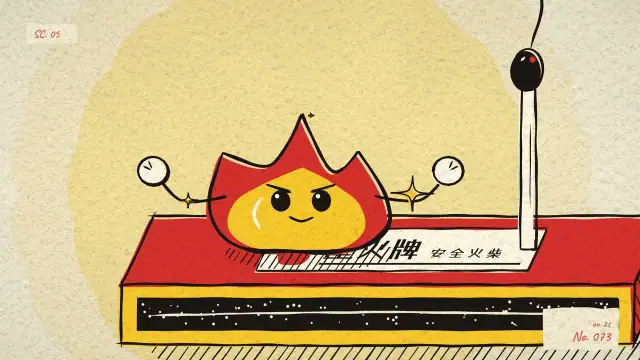
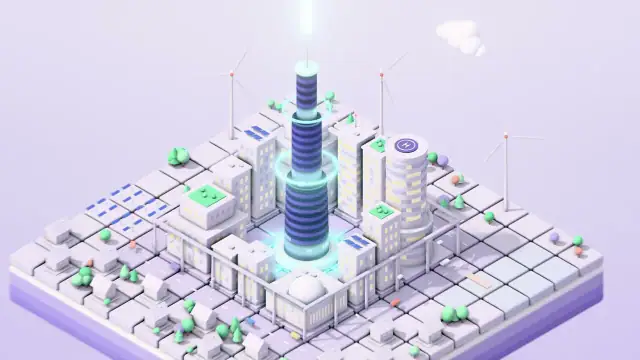
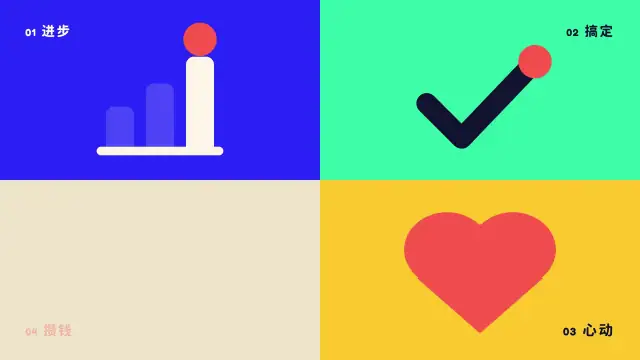
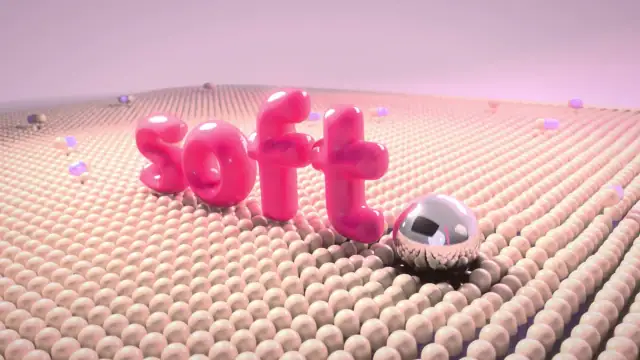
Sticker Explainer 贴纸风 / 科普
How Many Elements Hide in a Phone?·10s·MG Styles 15by Vincent Wei
The standard package of Chinese knowledge videos, made popular by PaperClip (回形针): photos are cut out and given a thick white outline to become stickers, laid out with flat icons and data charts on a huge canvas, while the camera pans and zooms from point to point. Finance and cross-disciplinary creators such as Lin Chao combine it with handwritten notes and formula cards. It is still the dominant format for hard-science, finance and corporate explainers.
You are the director, motion designer, engineer and sound designer of ONE 10-second motion-design film.
The goal is the most classic, yet most stunning form of this style — award-shortlist / high-end commercial quality. A clean,
template-looking result is a fail. Benchmarks: Buck, ManvsMachine, Ordinary Folk, Giant Ant, Territory Studio, Apple keynote
motion, Pentagram motion identities, top Behance/Motionographer features, top 抖音/B站 designer accounts.

# Style
粗描边贴纸人科普 MG(回形针/林超风格) Bold-outline Sticker Explainer MG (PaperClip / Lin Chao style)

# Output (fixed)
- 1920×1080, 30 fps, exactly 10.000 s (300 frames), H.264 MP4 with stereo AAC audio (48 kHz), mastered to −14 LUFS
  integrated, true peak ≤ −1 dBTP. Final file: video.mp4.

# Suggested technical route
HTML: one huge canvas (e.g. 6000×3000 px) with a camera transform (long eases), SVG charts, photo stickers with 10px white outline
(You may choose a better route if it clearly raises quality; say why.)

# Creative seed
「回形针式硬核科普」The PaperClip-style knowledge-video look: sticker-ized photos + flat icons + precise charts on a giant canvas with continuous camera moves.
- Topic (write your own tight copy), e.g. 「一部手机里,藏着多少种元素?」.
- Calm blue-grey/off-white canvas (#E9EEF2 + slate), 2–3 colours + one accent (e.g. #FF5A36); equal-weight sans typography, strict alignment.
- One continuous camera path: sticker phone photo (white 10px outline, soft shadow) → exploded-parts stickers with leader-line labels → periodic-table grid where element tiles light up → bar chart grows with count-up "70+" → world map with supply routes drawing → pull out to a bold typographic title card in the 回形针 manner (heavy sans, huge number, small caption).
- Every beat introduces a new visual element; charts are exact (bars to scale, numbers consistent).
Sound: clean tech-explainer bed, UI clicks, ticking during count-up, soft whoosh on camera moves.

You are the director: you may change the concept, copy, story beats and brand names if you find a stronger idea, but the result must remain the CANONICAL, instantly-recognisable form of this style and must hit its signature features below.

# Signature features and key techniques (the result is judged against these)
回形针 PaperClip 带火的知识区标准包装:实拍图片抠图后加粗白描边变成『贴纸』,与扁平图标、数据图表一起铺在大画布上,镜头平移缩放串联信息点;林超等财经/跨学科 UP 主将其与手写板书、公式卡片结合。至今仍是硬核科普、财经知识区、企业宣传片的主流范式。
视觉特征 照片贴纸化(粗白描边), 蓝灰/米白冷静底色, 扁平图标+精确数据图表, 大画布镜头平移缩放, 信息密度极高的节拍化叙事
关键技法 素材照片抠图 + 8~12px 白描边统一质感,消除图片来源差异
超宽大画布布局,摄像机层做平移/缩放(ease 长曲线),一镜串多个信息点
图表动效:柱状图生长、数字滚动计数、路径描边生长
解说词逐句驱动画面元素入场,语速快、每句必有新视觉元素
克制配色(2~3 色)+ 等线字体,保持『严肃感』

# How to work
1. Treatment. Write down one clear idea: a hook in the first 0.5 s (never open on more than 0.3 s of empty or black), an
   escalation, one unmistakable hero moment at ~60–75 % of the runtime, and a composed end frame held ~0.8–1.2 s with living
   micro-motion. Map every signature feature above to a moment. Keep one cue sheet (beats and hit times) that both the
   picture and the sound read from.
2. Key frames before motion. Build the look, render stills at 6–10 key times and actually look at them. Each still should be
   poster-worthy: composition, hierarchy, negative space, type set properly (kerning, line-height, weight contrast, CJK
   punctuation, ~5 % safe margins). Iterate until nothing looks default, generic, cramped or "AI-template".
3. Motion. Build the choreography and preview at low resolution. Step through the fastest moves frame by frame: spacing,
   easing, arcs, overlap, anticipation and follow-through, motion blur. No unintended dead spans; the energy follows the music.
4. Sound. Write genre-correct music and sound design locked to the cue sheet. Check that visual hits land on audio onsets.
   Master to the output spec.
5. Final. Render at full resolution (motion blur where apt), then check: exactly 10.00 s, resolution, fps, audio present and at
   the right loudness, no black frames, no fallback fonts or tofu, no clipped elements at the frame edges, no shimmer on thin
   lines, no gradient banding. Fix and repeat until you would submit it to a festival.
6. Write an honest self-critique: what is strongest, what is weakest, what you would do with more time.

# Rules
- Rendering must be deterministic: every frame is a pure function of time t. Seeded randomness only; physics and particles
  precomputed or closed-form; no real-time clocks; no state-triggered CSS transitions. A reliable route: a web page that can
  draw any time t on request, captured frame by frame with a headless browser and encoded with ffmpeg (or a Blender script
  that renders a PNG sequence).
- Assets: only CC0 / public domain / OFL / Apache / free-for-commercial-use. Record each source and licence in CREDITS.md.
  No real brand trademarks; invent brand names.
- On-screen text must be correct and natural: idiomatic Chinese, proper CJK punctuation, no typos.

# Craft checklist (what a jury looks for)
- Style authenticity: an expert names the style in one second; every signature technique is present and executed correctly.
- Motion craft: purposeful easing (no linear unless mechanical by design), overlap and stagger, anticipation and
  follow-through, arcs, squash and stretch where the style allows, consistent physics, motion blur where apt; transitions
  carried by elements, not crossfades.
- Rhythm: hits locked to the music; contrast between busy and calm; no monotony.
- Design: strong composition, grid, typographic hierarchy, controlled palette; texture and finishing (grain, glow, vignette)
  only where the style wants it; nothing looks accidental.
- Technical polish: no jitter (unless intended), no popping, no aliasing, no banding, no fallback fonts, no half-loaded images.
- Sound: genre-correct, musical, synced, mastered.

# Before you deliver, score yourself honestly
1–10 on style fidelity, concept wow, motion craft, design & typography, finish & texture, sound & sync, technical
(6 = template-level, 8 = high-end agency, 9 = award shortlist). Aim for 9; fix whatever scores lowest first.

# Deliver
video.mp4, plus a short report: the concept in two sentences; a beat sheet with timecodes; how each signature feature is
realised; the tech route; check numbers (duration, resolution, fps, loudness, true peak); your honest top-3 weaknesses.
How to use it
- Create an empty folder and open an AI assistant that can write code and run commands in it (for example Claude Code). The machine needs web rendering (Node + Chrome) and ffmpeg.
- Copy the whole prompt below and send it.
- To make it your own: change the story, brand name, copy and colours in
Creative seed, or the size inOutput(e.g. vertical 1080×1920). Do not deleteSignature features: it is what makes the style recognisable at a glance. - To push it further: once the film is done, have a second AI review it with rubric.md and paste the review back to the maker for another round. The original films went through two such rounds.